Cart
0
In today's world, every food seems to be judged by two numbers: calories and glycemic index (GI).
Consumers scan labels, count macros, and search for the "healthiest" sweetener. Amidst this search, an age-old ingredient quietly continues to hold its place in Indian kitchens—jaggery.
But is jaggery really better than sugar? And does it still deserve a place in the modern diet?
The answer lies not in marketing claims, but in understanding why our ancestors valued it in the first place.
More Than Just Sweetness
For centuries, jaggery was not viewed as a dessert ingredient. It was considered a nourishing food.
Across India, farmers would often begin their day with a small piece of jaggery. It accompanied meals, celebrations, seasonal transitions, and even long hours of physical work.
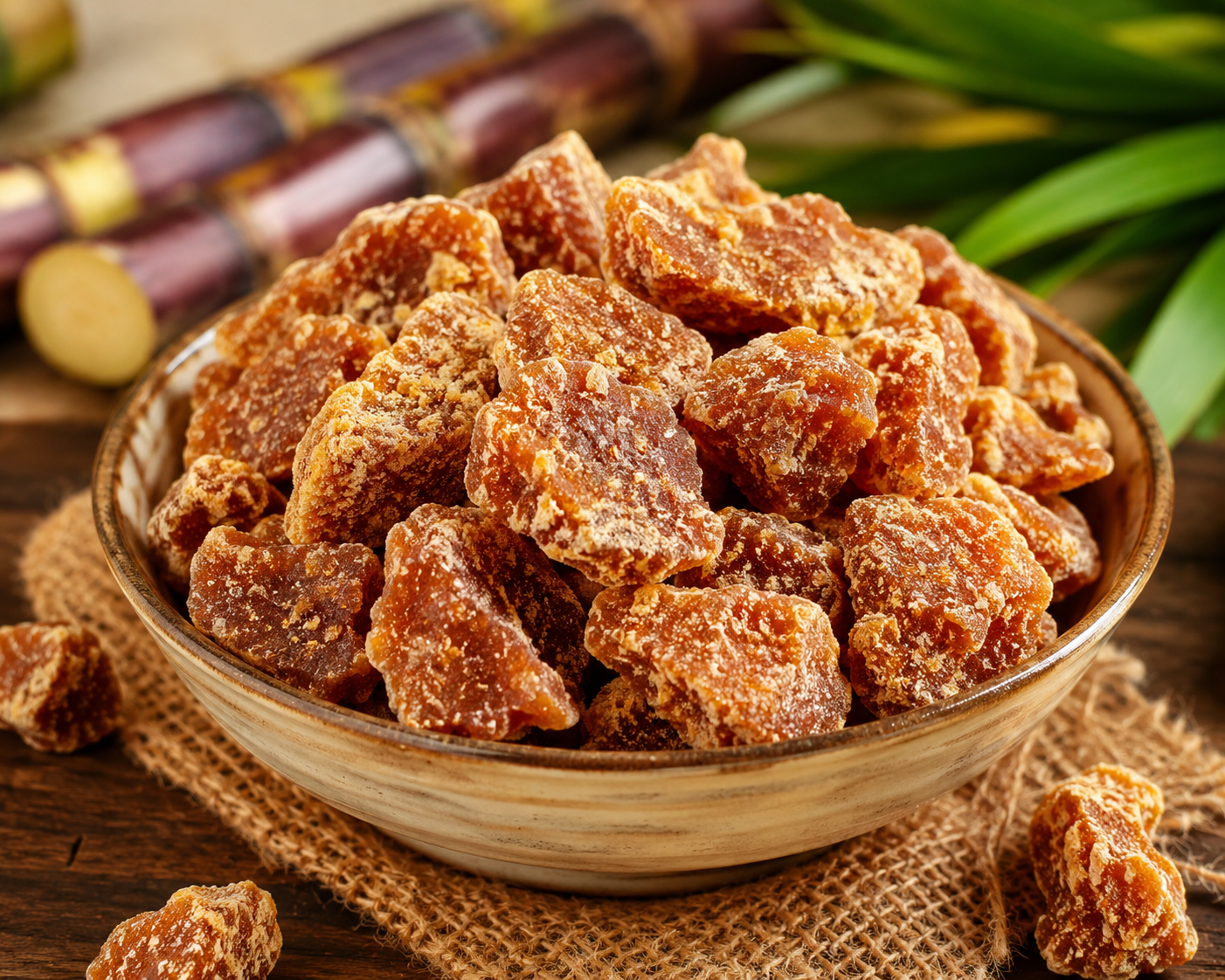
Unlike refined sugar, jaggery is made by slowly concentrating fresh sugarcane juice without stripping away all of its naturally occurring minerals. The result is a sweetener that remains closer to its natural form.
Its value was never just in sweetness—it was in the nourishment that came along with it.
The GI Question
One of the most common questions today is:
"Does jaggery have a lower glycemic index than sugar?"
The honest answer is that jaggery is still a form of sugar and can raise blood glucose levels. It should not be viewed as a free-pass sweetener.
However, this is where context matters.
Our ancestors did not consume jaggery in isolation. It was typically eaten in small quantities, often alongside meals rich in fibre, fats, and proteins.
The problem today is not merely sugar.
It is excessive sugar consumption.
Replacing refined sugar with jaggery while maintaining mindful portions can be a more traditional and minimally processed approach to sweetness—but moderation remains essential.
Calories: Looking Beyond the Numbers
A teaspoon of jaggery and a teaspoon of sugar contain similar calories.
This surprises many people.
So why choose jaggery?
Because nutrition is not always about calories alone.
Two foods may provide similar energy, yet differ significantly in how they are produced, processed, and experienced by the body.
Jaggery is valued not because it is calorie-free, but because it remains closer to the ingredient nature intended.
Sometimes the quality of food matters just as much as the quantity.
Why Jaggery Still Matters Today
Modern lifestyles have changed, but our need for real food has not.
Consumers today are increasingly seeking:
• Fewer processed foods
• Traditional ingredients
• Transparency in sourcing
• Authentic methods of production
Jaggery aligns naturally with these values.
It reminds us that food does not always need to be engineered, fortified, or reformulated. Sometimes the simplest foods are the ones that have stood the test of time.
A Lesson from Our Ancestors
Our ancestors did not have calorie-tracking apps or GI charts.
Yet they understood an important principle:
Food should nourish, satisfy, and connect us to the rhythms of nature.
Jaggery was never consumed in excess. It was respected, enjoyed, and incorporated thoughtfully into daily life.
Perhaps that wisdom is more relevant today than ever before.